
Remote employees in Mexico
Onboarding Remote Employees in Mexico When Nobody From HQ Is Around
How to onboard and keep remote employees in Mexico: the paperwork the law asks for, the telework rules and the first-week follow-up that stops early quits.
Short answer. Before day one, have the written contract (with the telework terms if they'll work from home more than 40% of the time), the equipment and the social security registration ready; Mexican law gives the employer 5 business days to register a new employee with the IMSS. Then plan the first weeks as carefully as the hiring: a named person who welcomes them, a clear first week, and someone they can call when they have doubts. New hires who feel alone leave early.
One of our longest clients is an eye clinic.
We've worked with them for more than four years. Their headquarters is in San Luis Potosí, "many kilometers from Baja California", where the clinics we recruit for operate. (Quotes translated from Spanish.)
That distance showed up in every new hire.
"When they start working, they get very little support from the company. There's no director present, there's no HR department present."
And "many people, when they start, feel uncertainty."
We've recruited more than 70 people for that clinic. And by staying close to them in those first weeks, we've helped rescue maybe ten or twelve of their employees.
A remote employee doesn't quit the company. They quit the silence.
What paperwork does a new employee in Mexico need?
Before or on the first day:
| Item | Why | Legal basis |
|---|---|---|
| Written contract | Working conditions must be in writing, with a copy for each side | LFT, arts. 24 and 25 |
| Telework terms | If they work from home more than 40% of the time: equipment, the home-office costs you cover, contact and supervision, hours | LFT, arts. 330-A and 330-B |
| IMSS registration | Register the employee within 5 business days | Ley del Seguro Social, art. 15, I |
| Employee file | ID, tax ID (RFC), population ID (CURP), proof of address, bank details | Your internal file |
When clients ask us, we help with this part: going to the company, helping "manage the documentation, put together the new employee's file". It "has no additional cost".
What do I have to provide to a remote employee in Mexico?
The telework chapter of the Federal Labor Law lists the employer's obligations (LFT, art. 330-E):
- Equipment. Provide, install and maintain what the job needs, such as a computer or an ergonomic chair.
- Pay on time. Receive the work and pay wages as agreed.
- Home-office costs. Telecom services and the proportional share of electricity.
- A record of supplies. Keep track of what you've handed over.
- Data security. Mechanisms that protect the information they handle.
- Right to disconnect. No work expected after the working day ends.
- Social security. Enroll them in the mandatory system.
- Training. Help them use the tools, especially if they're moving from on-site to remote.
Ship the equipment so it arrives before day one. A new hire waiting for a laptop is a new hire wondering whether they made the right choice.
How do I run the first week for a remote employee in Mexico?
Like a welcome, not like a login.
What we do when we accompany a new hire: "we welcome them, we introduce them to the company, we let the candidate know we're also working with them."
A first week that works:
- Day 1. A video call with their manager and the team. Who's who, who to call for what.
- Day 1. Their access, their equipment working, their first small task.
- Days 2 to 4. One short check-in a day. Ten minutes is enough.
- Day 5. A conversation about how the week went, in their language. What's unclear? What's missing?
And give them a person to call. At the clinic, "people come to us a lot". We tell every hire: "any question or any need you have, if you need to ask us, we'll gladly help."
What do I do when a new hire is struggling?
Talk to them first. Then talk to leadership.
With the clinic, our practice is simple: "we talk with them, we explain the process, we ask them for patience." We work at calming them down.
When it's not enough, we escalate: "we also inform leadership, so they find a way to give them more support, even if it's at a distance."
That support can be in person or "through getting in touch with the directors, or with the people in their department, and accompanying them so this start is a little less complicated."
The cost of not doing it is concrete. People "who accept and leave a few weeks later" mean starting the search again.
How does onboarding look from each side?
If you're the founder, onboarding is where the hiring investment either compounds or evaporates.
If you're the manager in the US, your new hire can't read your face across an office. Say out loud what you'd normally show: that their work is good, that questions are welcome.
If you're HR, the paperwork and the telework terms protect both sides. Get them done before day one.
If you're the new employee, uncertainty in the first weeks is normal. A company that calls you first is telling you something.
Every side wants the first month to end with the same answer: "I'm staying."
Frequently asked questions
Is there a probation period for remote employees in Mexico? Yes, the same as for anyone: up to 30 days, or up to 180 for management and specialized roles, with all statutory benefits during it (LFT, art. 39-A).
Do I have to pay for my remote employee's internet? When the person is a teleworker under the law, the employer covers telecom services and the proportional share of electricity (LFT, art. 330-E, III). Put the amount in the contract (LFT, art. 330-B).
Can I message my remote employee after hours? The law gives teleworkers a right to disconnect at the end of the working day (LFT, art. 330-E, VI). Keep after-hours contact for real emergencies.
How long should onboarding last? The paperwork, a week. The follow-up, at least the probation period.
This guide is general information, not legal advice. For your specific case, talk to a Mexican labor lawyer or accountant.
What's next
Summary in 4 lines:
- Contract, telework terms, equipment and IMSS registration before day one.
- Under the telework rules you provide equipment, pay part of internet and electricity, and respect disconnection.
- A named welcome, daily check-ins in week one, and a person to call.
- When someone struggles, talk to them, then to leadership.
We recruit remote employees in Mexico for US and Canadian companies and, when you ask, support their onboarding at no extra cost.
Written with Adriana Molina, Managing Director of LM Recruitment. Based on her October 2026 interviews; quotes translated from Spanish.
Sources: LM Recruitment interviews with Adriana Molina (October 2026; literal quotes, translated from Spanish and edited only to remove pauses). Ley Federal del Trabajo on mLey: art. 24, art. 25, art. 39-A, art. 330-A, art. 330-B and art. 330-E. Ley del Seguro Social, art. 15. The first-week plan is LM Recruitment's editorial guidance.
Filed under English Content
Keep reading
English Content
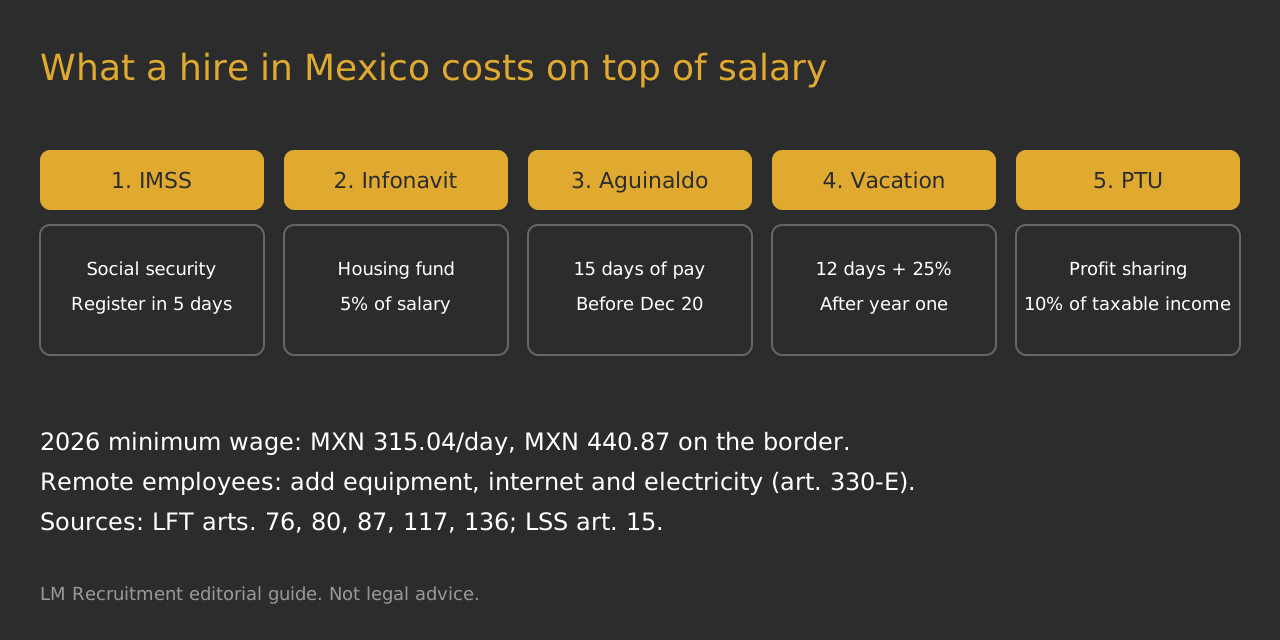
What It Costs to Hire an Employee in Mexico in 2026
Minimum wage, aguinaldo, vacation, IMSS, Infonavit and profit sharing: what an employee in Mexico really costs in 2026, with the law behind each line.
English Content
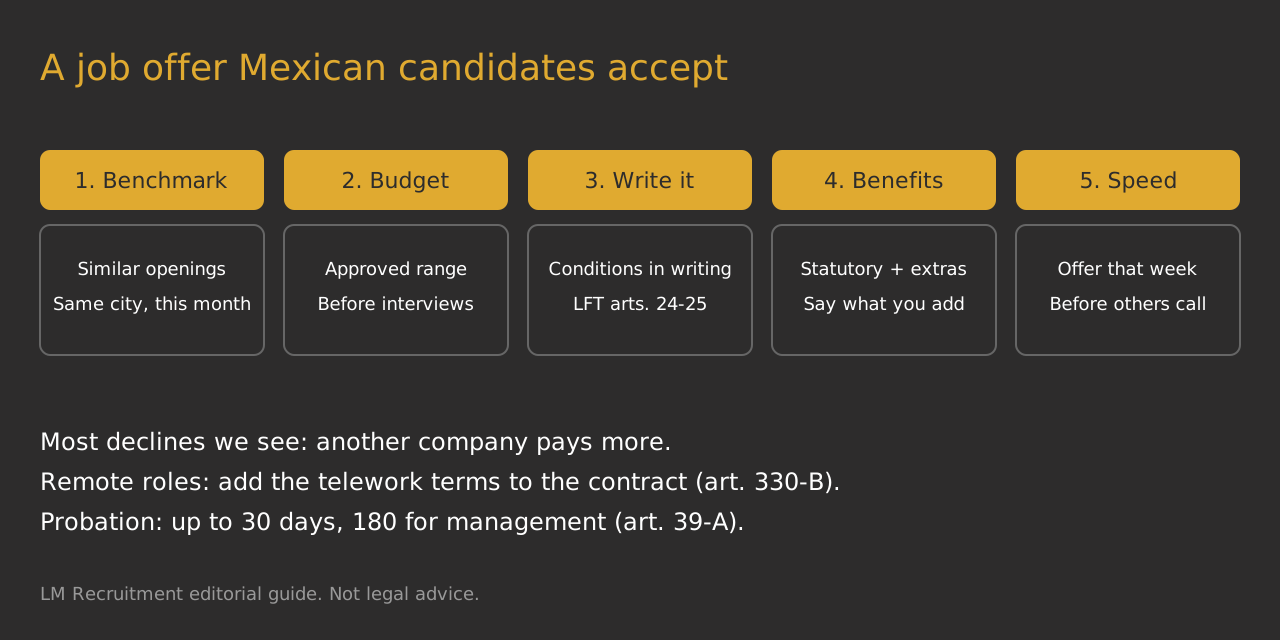
How to Make a Job Offer Mexican Candidates Accept
Why good candidates in Mexico turn down offers, how to benchmark salary against similar roles, and what a formal offer must include under Mexican law.
English Content
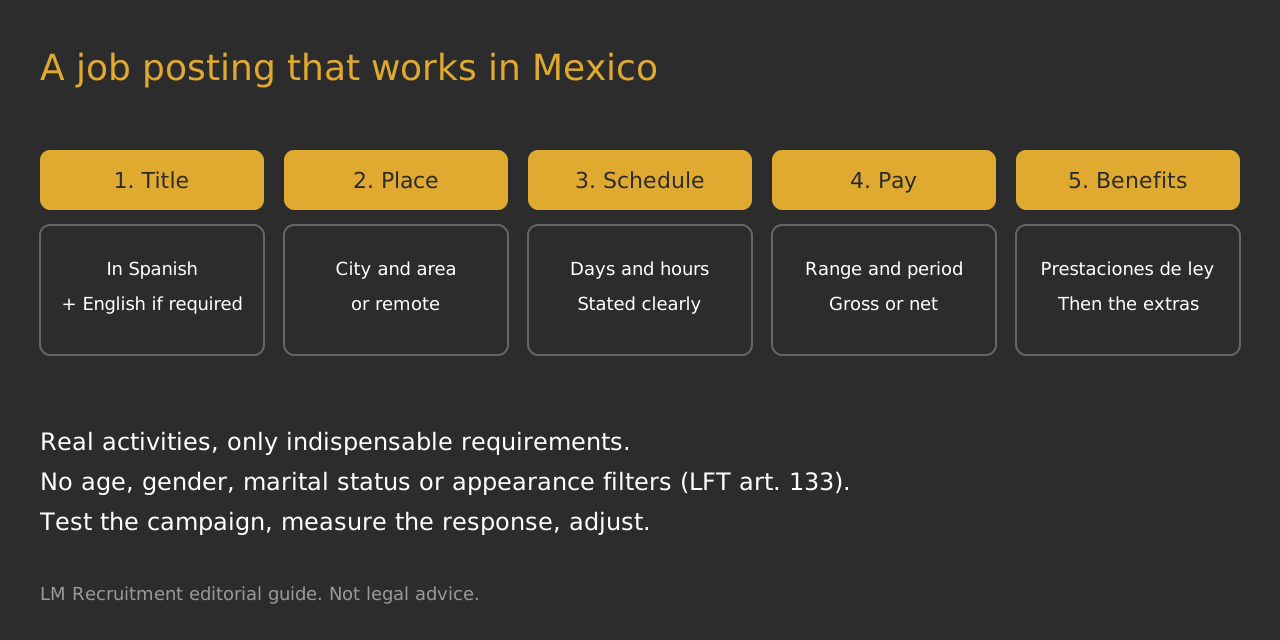
How to Write a Job Posting That Works in Mexico
What candidates in Mexico look for first, what makes a job posting look informal, and what Mexican law doesn't let you ask for. A checklist for US employers.