
Hiring in Mexico
How to Make a Job Offer Mexican Candidates Accept
Why good candidates in Mexico turn down offers, how to benchmark salary against similar roles, and what a formal offer must include under Mexican law.
Short answer. Candidates in Mexico turn down offers mostly for one reason: someone else pays more. Benchmark your salary against similar openings before you publish, put every condition in writing, include all statutory benefits and say what you offer above them, and move fast once you have a finalist. A complete offer that arrives in days beats a vague one that arrives in weeks.
The candidate had already started the clinic's induction course.
Then she called me.
"She apologized. And she told me she had a much, much better offer."
I asked what the offer was, to take it to the owners and see if we could keep her. It was out of reach: "they offered her almost double what I did." (Quotes translated from Spanish.)
Every time this has happened to us, the reason has been the same. Pay.
A job offer in Mexico isn't judged on its own. It's judged against the other offers on the candidate's phone.
Why do candidates in Mexico reject job offers?
In our searches, the reason is almost always money. Sometimes "a lot more money".
But money is the symptom. The cause is usually upstream:
- The offer doesn't match the profile. "We very often find that companies have a very high expectation, and a very low job offer."
- The company isn't ready to make an offer. "Sometimes companies aren't prepared to make an offer." The budget, the approvals or the start date aren't defined when the finalist appears.
- The offer doesn't fit what people are looking for. And when it doesn't, the risk isn't only a no. It's a yes that ends badly: people "who accept and leave a few weeks later".
When a candidate declines, we always ask why. We run a short survey "to find out what happened, where we failed, and whether we can improve the offer."
How do I benchmark salary for a role in Mexico?
Look at what similar companies offer for the same role, in the same city, this month.
That's what we do before every search: "we analyze similar openings for similar profiles, and we give the client evidence of how much the competition is offering."
A practical way to do it:
- Collect 10 to 20 live postings for the same title and seniority, in the same city or for remote roles in Mexico.
- Write down the salary and the benefits each one shows, including benefits above the legal minimum (food vouchers, private medical insurance, savings fund).
- Place your offer in that range. If it's in the bottom quarter, expect fewer applicants and more declines.
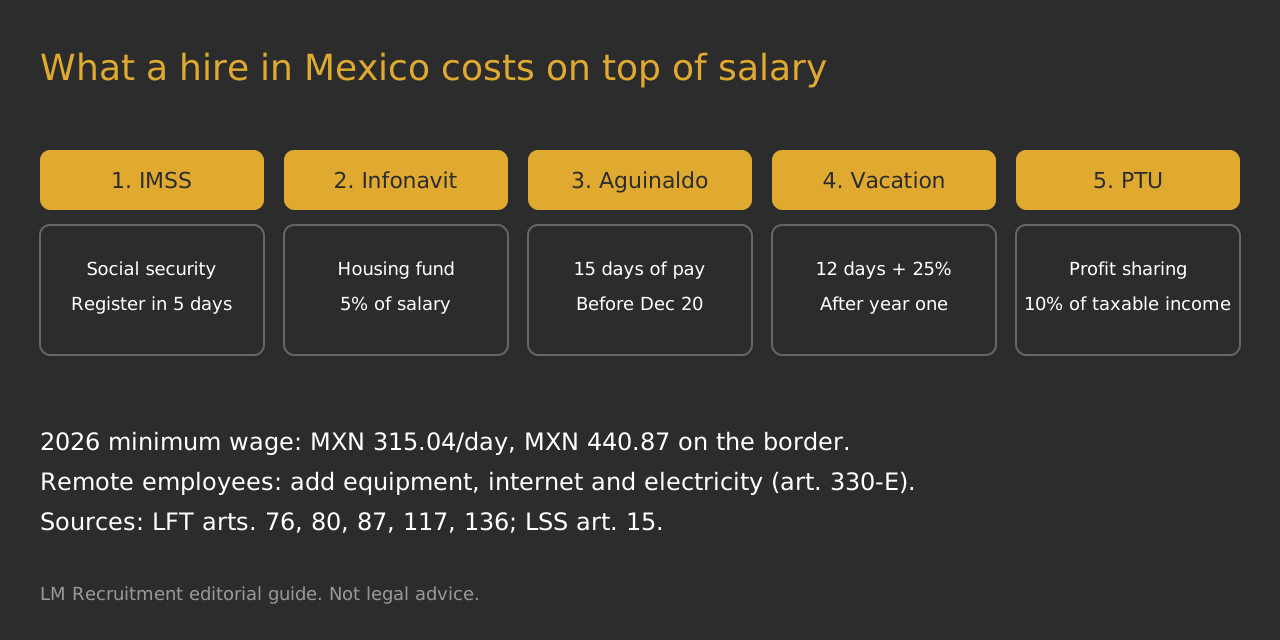
- Check the legal floor. In 2026 no salary can go below MXN 315.04 a day, or MXN 440.87 a day in the northern border zone. See what it costs to hire an employee in Mexico for the full list of statutory costs.
When the numbers don't match, we don't push. "So the client doesn't feel pressured or offended, we back it up with information."
And when the gap is too large, we step back. "We withdraw from the offer."
It sounds harsh. It protects everyone. A posting far below the market also hurts the campaign itself: "we get a lot of hate from people" in the comments of the ads.
What must a formal job offer include in Mexico?
Under Mexican law, working conditions must be in writing when there's no collective agreement (LFT, art. 24), with a copy for each side.
The written conditions include, among other things (LFT, art. 25):
| Item | What to state |
|---|---|
| Who is hiring | The employer's name and address |
| The job | Title and the services to be provided |
| Term | Indefinite, fixed-term or for a specific project; any probation period |
| Where | The workplace, or the remote setup |
| Hours | The working schedule |
| Pay | Salary amount, and the day and place of payment |
| Training | That the employee will receive training under your plans |
| Benefits | Vacation, rest days and other conditions agreed |
If the person works from home more than 40% of the time, the contract also has to cover the equipment you provide, the home-office costs you pay, and how you'll stay in contact (LFT, art. 330-B).
A probation period can last up to 30 days, or up to 180 days for management and specialized roles (LFT, art. 39-A).
How fast should I make the offer?
Faster than you think.
A strong candidate in Mexico is usually in more than one process. Each day between the final interview and the offer is a day another company can call.
Define these before you interview finalists:
- The approved salary range.
- Who signs the offer.
- The earliest start date.
- The benefits you'll put in writing.
Then, when you find the person, you can make the offer the same week.
How does a job offer look from each side?
If you're the founder, the offer is where the whole search pays off or falls apart. A few hundred dollars a month above the bottom of the market is cheaper than starting over.
If you're the hiring manager, a vague offer creates doubt. Everything you put in writing is a reason to say yes.
If you're HR in the US, adapt the offer to Mexico. Aguinaldo, vacation premium and social security aren't perks here: they're the minimum.
If you're the candidate, you're comparing the full package, not only the salary. And you're comparing it today.
The best offer isn't always the highest. It's the clearest one that arrives first, close to the market.
Frequently asked questions
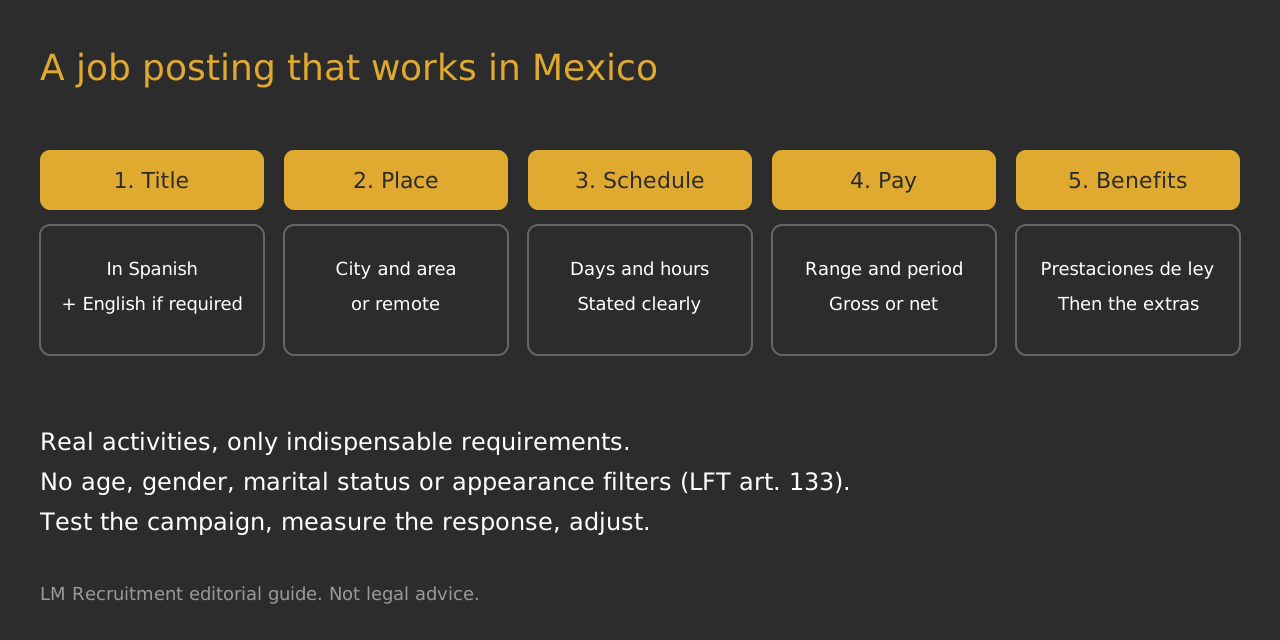
Should I publish the salary in the job posting? We recommend it. A posting that hides the pay makes candidates guess, and a clear range keeps out people your budget can't reach. See how to write a job posting that works in Mexico.
Can I make a counteroffer when a candidate gets a better offer? You can try. We always ask what the other offer is and take it to the client. When the gap is close to double, as in our clinic case, it rarely works.
Do I have to offer more than the statutory benefits? No. But the benefits above the legal minimum are often what tip a decision between two similar salaries.
Can I hire someone with a verbal offer? The employment relationship exists anyway, but Mexican law requires the conditions in writing (LFT, art. 24). Put them in writing.
This guide is general information, not legal advice. For your specific case, talk to a Mexican labor lawyer.
What's next
Summary in 4 lines:
- Candidates in Mexico decline mainly because someone else pays more.
- Benchmark against similar openings before you publish.
- Put every condition in writing, including remote-work terms.
- Decide the budget before the final interview, and make the offer that week.
If you want salary evidence for your role before you go to market, we recruit employees in Mexico for US and Canadian companies, and every search starts with that benchmark.
Written with Adriana Molina, Managing Director of LM Recruitment. Based on her October 2026 interviews; quotes translated from Spanish.
Sources: LM Recruitment interviews with Adriana Molina (October 2026; literal quotes, translated from Spanish and edited only to remove pauses). Ley Federal del Trabajo on mLey: art. 24, art. 25, art. 39-A and art. 330-B. Minimum wage 2026: IDC Online, "Ya es oficial el monto de los salarios mínimos del 2026" (Dec 9, 2025). The benchmarking steps are LM Recruitment's editorial method.
Filed under English Content
Keep reading
English Content
What It Costs to Hire an Employee in Mexico in 2026
Minimum wage, aguinaldo, vacation, IMSS, Infonavit and profit sharing: what an employee in Mexico really costs in 2026, with the law behind each line.
English Content
How to Write a Job Posting That Works in Mexico
What candidates in Mexico look for first, what makes a job posting look informal, and what Mexican law doesn't let you ask for. A checklist for US employers.
English Content
Interviewing Candidates in Mexico: What You Can't Ask and How to Screen Fairly
Which interview questions Mexican law rules out, how to screen for real job requirements by phone and video, and how to interview from the US and keep them.