
Hiring in Mexico
How to Write a Job Posting That Works in Mexico
What candidates in Mexico look for first, what makes a job posting look informal, and what Mexican law doesn't let you ask for. A checklist for US employers.
Short answer. Write it in Spanish, lead with the job title, the city or "remote", the schedule and the pay, and state that the job includes statutory benefits (prestaciones de ley). Describe the real activities in plain words. Leave out age, gender, marital status or appearance requirements: Mexican law doesn't let an employer reject candidates for those reasons. A vague posting doesn't just get fewer applicants; it looks informal.
When a company sends us a role, the first thing we read is the description.
Not to fix the wording. To decide whether we can take it.
Some descriptions set off alarms right away: activities that sound "dubious", a description that "isn't clear", no sign of "formality". Others don't mention an "employer registration" or "statutory benefits". (Quotes translated from Spanish.)
Candidates read postings the same way. Fast, and looking for the same signals.
In Mexico, a clear job posting isn't only better marketing. It's proof that the job is real.
What do candidates in Mexico look for first in a job posting?
In order, the questions a candidate is trying to answer in the first seconds:
- What's the job? A title they recognize, in Spanish.
- Where? The city and area, or "remote" (many postings in Mexico say home office).
- When? The schedule and the days.
- How much? The salary, gross or net, weekly, biweekly or monthly.
- Is it formal? "Prestaciones de ley" and any benefits above them.
If those five answers aren't visible, many candidates move to the next posting.
How should I structure a job posting for Mexico?
This structure works for most roles:
| Section | What to write | Example |
|---|---|---|
| Title | The common title in Spanish, plus the English title if English is required | Ejecutivo de atención a clientes (bilingüe) |
| Location | City and area, or remote within Mexico | Tijuana, zona Río / Home office, México |
| Schedule | Days and hours | Lunes a viernes, 9:00 a 18:00 |
| Pay | Range and period | $18,000 a $22,000 mensuales brutos |
| Benefits | Statutory benefits, then the extras | Prestaciones de ley, seguro de gastos médicos |
| Activities | 4 to 6 real tasks, in plain words | Atender llamadas de clientes en EE. UU. |
| Requirements | Only what's indispensable | Inglés conversacional, 1 año en atención a clientes |
| How to apply | One clear step | Envía tu CV por WhatsApp o en el formulario |
The salary range in the example is illustrative. Benchmark your own against similar openings, as we explain in how to make a job offer Mexican candidates accept.
What makes a job posting look informal in Mexico?
The same signals we use to screen requests:
- No employer behind it. For us to accept a role, it "must be a company, properly constituted, whether an individual or a legal entity, but it must be a formal company."
- No statutory benefits. A role we accept "must offer statutory benefits".
- Activities that don't add up. A description so vague that nobody can tell what the job is.
- Hidden conditions. We have no problem with commission-only sales roles. "The problem is when they lie to us, because then we would be lying to the people we recruit."
If your posting is honest about the hard parts (a night shift, a commission-heavy pay plan, a demanding target), say so. It filters people better than hiding it.
What can't I ask for in a job posting in Mexico?
Mexican law forbids employers to refuse to hire workers because of ethnic or national origin, gender, age, disability, social condition, health, religion, opinions, sexual preference or marital status (LFT, art. 133, I).
It also forbids requiring a certificate of non-pregnancy to hire someone (LFT, art. 133, XIV).
In practice, leave these out of the posting:
- Age ranges ("de 25 a 35 años").
- Gender ("solo hombres", "señorita").
- Marital status or "no children".
- Appearance or "buena presentación" used as a filter.
Write the real requirement instead. If the job requires climbing poles or lifting weight, describe the task. We explain how to screen for it fairly in interviewing candidates in Mexico.
Where should I publish a job posting in Mexico?
Where your candidates already are. For operations roles that's often social media and local job boards; for office and remote roles, job boards and professional networks.
We don't rely on one channel. For every search, our process starts with a test: "let's make an attempt. Let's run the advertising. Let's see how people respond." With most campaigns we have a reasonable group of candidates to start evaluating within about a week.
And if the test doesn't work, we stop, show the client the evidence, and "decide together whether to continue or not."
How does a job posting look from each side?
If you're the founder, the posting is your first contact with your future team. It should sound like the company you want them to join.
If you're the hiring manager, the posting decides who applies. Every vague line becomes ten unqualified applications.
If you're the recruiter, a clear posting makes the phone screen shorter: the candidate already knows the pay, the schedule and the place.
If you're the candidate, the posting is all you have to decide whether to spend your time. Pay, place and formality first.
Every side wants the same thing from a posting: fewer surprises later.
Frequently asked questions
Should the posting be in Spanish or English? In Spanish, unless English is a requirement. For bilingual roles, a Spanish posting with the English title and the required English level works well.
Should I publish gross or net pay? Say which one it is. Candidates in Mexico often think in net monthly pay, so if you publish gross, label it bruto.
Can I ask for a recent photo with the CV? It's common in Mexico, but don't use appearance as a filter: rejecting candidates for discriminatory reasons is prohibited (LFT, art. 133, I).
How long should the posting be? Short enough to read on a phone. The eight sections in the table above, a line or two each.
This guide is general information, not legal advice. For your specific case, talk to a Mexican labor lawyer.
What's next
Summary in 4 lines:
- Spanish, with title, place, schedule, pay and benefits up front.
- Real activities and only indispensable requirements.
- No age, gender, marital status or appearance filters (LFT, art. 133).
- Test the posting, measure the response, adjust.
If you'd rather not run the campaign yourself, we write the posting, run the campaigns and screen candidates for remote and on-site roles in Mexico. You only meet the finalists.
Written with Adriana Molina, Managing Director of LM Recruitment. Based on her October 2026 interviews; quotes translated from Spanish.
Sources: LM Recruitment interviews with Adriana Molina (October 2026; literal quotes, translated from Spanish and edited only to remove pauses). Ley Federal del Trabajo on mLey: art. 133 (fractions I and XIV). The posting structure, the example lines and the channel advice are LM Recruitment's editorial guidance; the salary range in the example is illustrative, not market data.
Filed under English Content
Keep reading
English Content
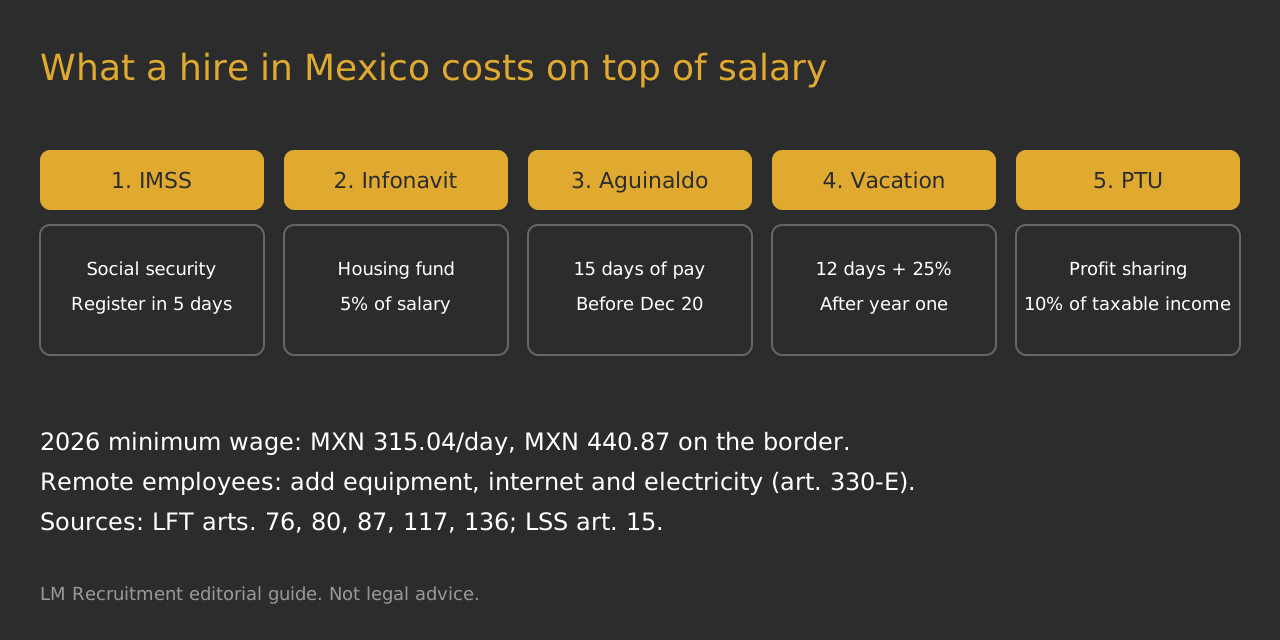
What It Costs to Hire an Employee in Mexico in 2026
Minimum wage, aguinaldo, vacation, IMSS, Infonavit and profit sharing: what an employee in Mexico really costs in 2026, with the law behind each line.
English Content
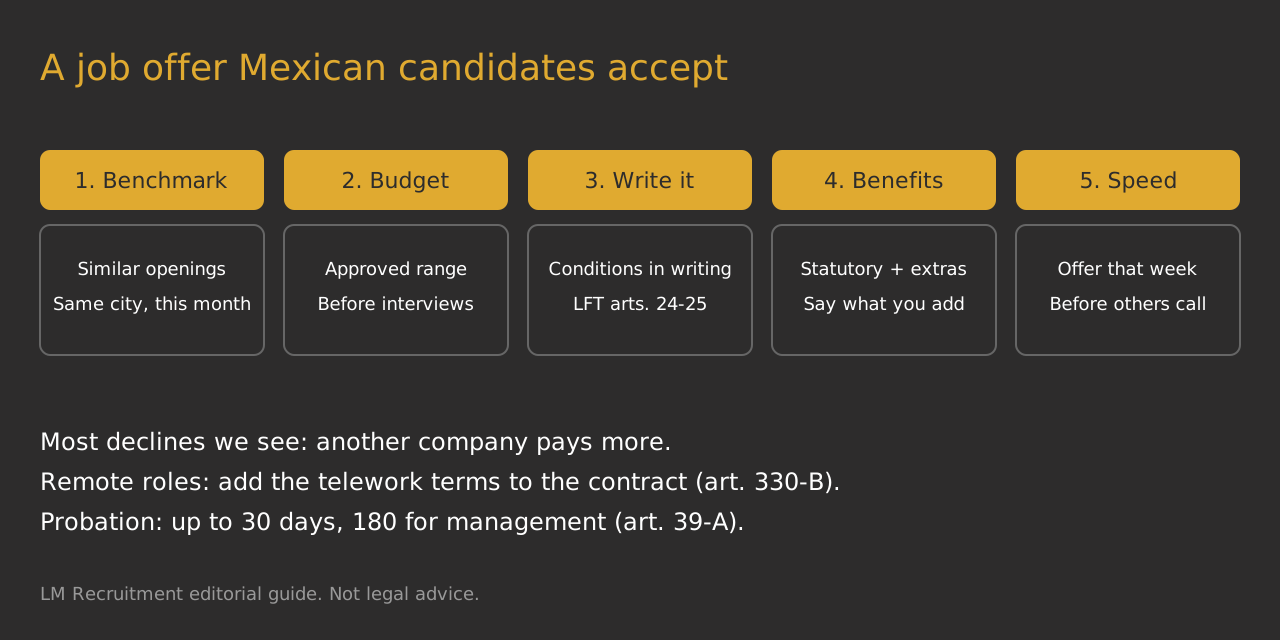
How to Make a Job Offer Mexican Candidates Accept
Why good candidates in Mexico turn down offers, how to benchmark salary against similar roles, and what a formal offer must include under Mexican law.
English Content
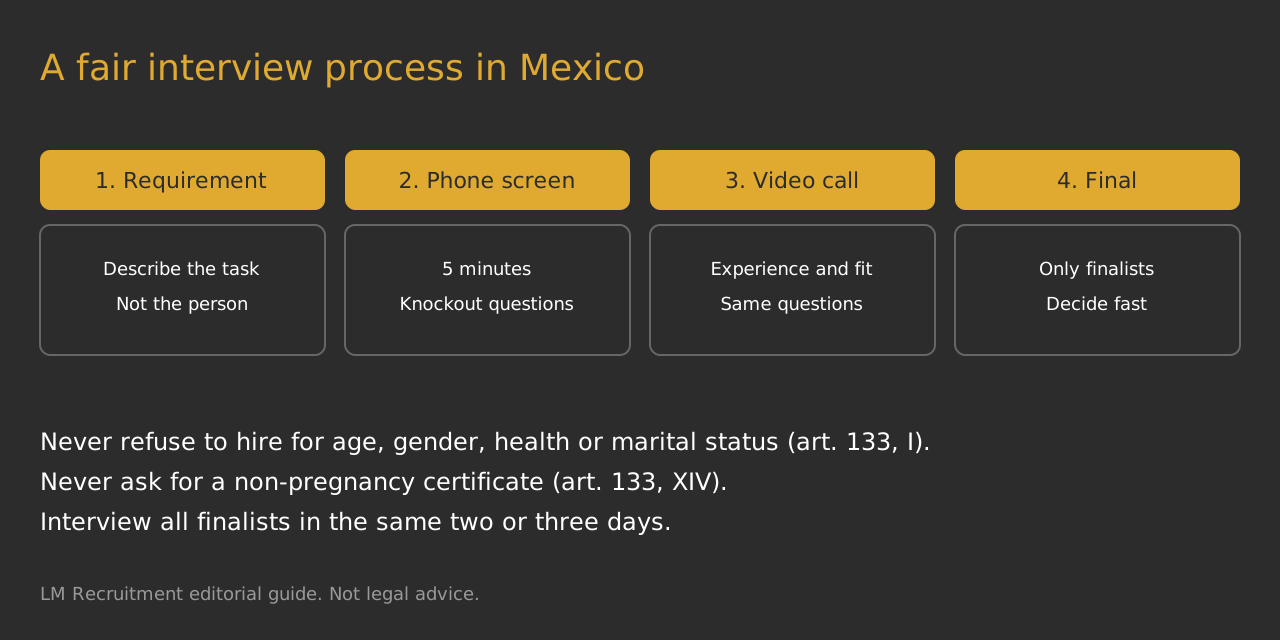
Interviewing Candidates in Mexico: What You Can't Ask and How to Screen Fairly
Which interview questions Mexican law rules out, how to screen for real job requirements by phone and video, and how to interview from the US and keep them.