
Hiring in Mexico
Interviewing Candidates in Mexico: What You Can't Ask and How to Screen Fairly
Which interview questions Mexican law rules out, how to screen for real job requirements by phone and video, and how to interview from the US and keep them.
Short answer. In Mexico you can't refuse to hire someone because of their gender, age, disability, health, religion, marital status, sexual preference or origin, and you can't ask for a non-pregnancy certificate (LFT, art. 133). Screen for the real requirements of the job instead: experience you can verify, skills you can test, and the physical or emotional demands of the role described as tasks. Pre-screen by phone, interview by video, and decide fast: slow, one-by-one interviews are where companies lose their best candidates.
We once had to recruit 100 fiber-optic installers in two weeks.
Part of the job was climbing poles and working at height.
There was a question we wanted to ask and couldn't. "There was an item we couldn't ask because it wasn't legal." (Quotes translated from Spanish.)
So we changed the method, not the requirement. In the call center, instead of asking, we did "a video call with the person to get a visual perception". The goal was safety: not to invite people "to take on work risks" they couldn't handle.
The question you can't ask usually hides a requirement you can describe.
What interview questions are illegal in Mexico?
The Federal Labor Law forbids employers to refuse to hire workers because of ethnic or national origin, gender, age, disability, social condition, health conditions, religion, opinions, sexual preferences, marital status, or any other criterion that could be discriminatory (LFT, art. 133, I).
It also forbids requiring a certificate of non-pregnancy to hire, keep or promote someone (LFT, art. 133, XIV).
Questions that put you at risk:
| Don't ask | Ask instead |
|---|---|
| How old are you? | Can you work the schedule this role requires? |
| Are you married? Do you have kids? | This role travels two days a month. Is that possible for you? |
| Are you pregnant or planning to be? | (Nothing. It's not part of the hiring decision.) |
| Do you have any illness? | The job involves lifting 20 kg several times a day. Can you do that? |
| What's your religion? | Can you work Saturdays? |
| Where are you from originally? | Do you have the documents to work in Mexico? |
The "ask instead" column works because it's about the task, not the person.
How do I screen candidates for a role in Mexico?
In three filters, from cheapest to most expensive:
- Phone pre-screening. Five minutes to confirm the basics: availability, location, salary expectation, and the one or two requirements that rule people in or out. In our high-volume searches, "the call center filtered the people who could qualify."
- Video interview. Experience and fit. For the installers, we looked at three factors. One was experience: "where they had worked and what kind of installation they had done." The client gave us criteria so we could tell "whether that person really knew how to work" with fiber.
- Final interview with you. Only the finalists. In that project, the process was to check the person qualified, move them to a second interview, and decide practically on the spot whether to hire.
For roles with people contact, the psychosocial profile matters as much as experience. "We work a lot with the medical sector. In the medical sector we need people who are resilient, who are empathetic."
How do I interview candidates in Mexico from the US?
By video, on a schedule that respects theirs.
A few things that help:
- Confirm the language. If the role needs English, say so in the posting and test it in the interview. If it doesn't, have a Spanish speaker on the call.
- Send the link and both times. Write the interview time in your time zone and in the candidate's, so nobody shows up an hour off.
- Keep the same questions for every candidate. It makes comparing easier and keeps the process fair.
- Give a date for the answer. And keep it.
Why do companies lose candidates during interviews?
Because they're slow.
"Processes can be very different. There are companies that are very slow, and they decide to interview all the candidates" one at a time.
We see it often: pre-qualified candidates contacted "one by one, with a lot of space in between, one a day. That makes it very tedious for us, and that's where we also lose candidates."
If you have five finalists, interview them in the same two or three days. Then decide.
How does an interview look from each side?
If you're the founder, a fair process protects you twice: from a bad hire and from a discrimination claim.
If you're the hiring manager, structured questions make the decision easier to defend, in Mexico or at headquarters.
If you're the recruiter, the phone screen is where you save everyone's time. Ask the knockout questions first.
If you're the candidate, a fast, clear process is a sign of how the company works. A slow one is too.
The fair interview and the fast interview turn out to be the same interview: clear requirements, same questions, quick decision.
Frequently asked questions
Can I ask for a medical exam before hiring? A medical exam linked to the real demands of the job is different from a discriminatory filter, but never ask for a non-pregnancy certificate (LFT, art. 133, XIV). Get legal advice on what your exam can include.
Can I ask about salary expectations? Yes. It's one of the most useful questions in the phone screen.
Can I record video interviews? Ask for the candidate's consent first, and tell them what you'll use the recording for.
How many interviews should a candidate in Mexico go through? For most roles, a phone screen and one or two interviews. Each extra round is another chance for a competing offer to arrive.
This guide is general information, not legal advice. For your specific case, talk to a Mexican labor lawyer.
What's next
Summary in 4 lines:
- Mexican law rules out hiring decisions based on age, gender, health, marital status and other personal traits.
- Describe the task, then screen for it.
- Phone screen, video interview, final interview: only finalists reach you.
- Interview finalists in the same few days and decide fast.
We run the phone screens and video interviews for employers hiring in Mexico from the US and Canada, and hand you a short list to interview.
Written with Adriana Molina, Managing Director of LM Recruitment. Based on her October 2026 interviews; quotes translated from Spanish.
Sources: LM Recruitment interviews with Adriana Molina (October 2026; literal quotes, translated from Spanish and edited only to remove pauses). Ley Federal del Trabajo on mLey: art. 133 (fractions I and XIV). The question table and the remote-interview tips are LM Recruitment's editorial guidance.
Filed under English Content
Keep reading
English Content
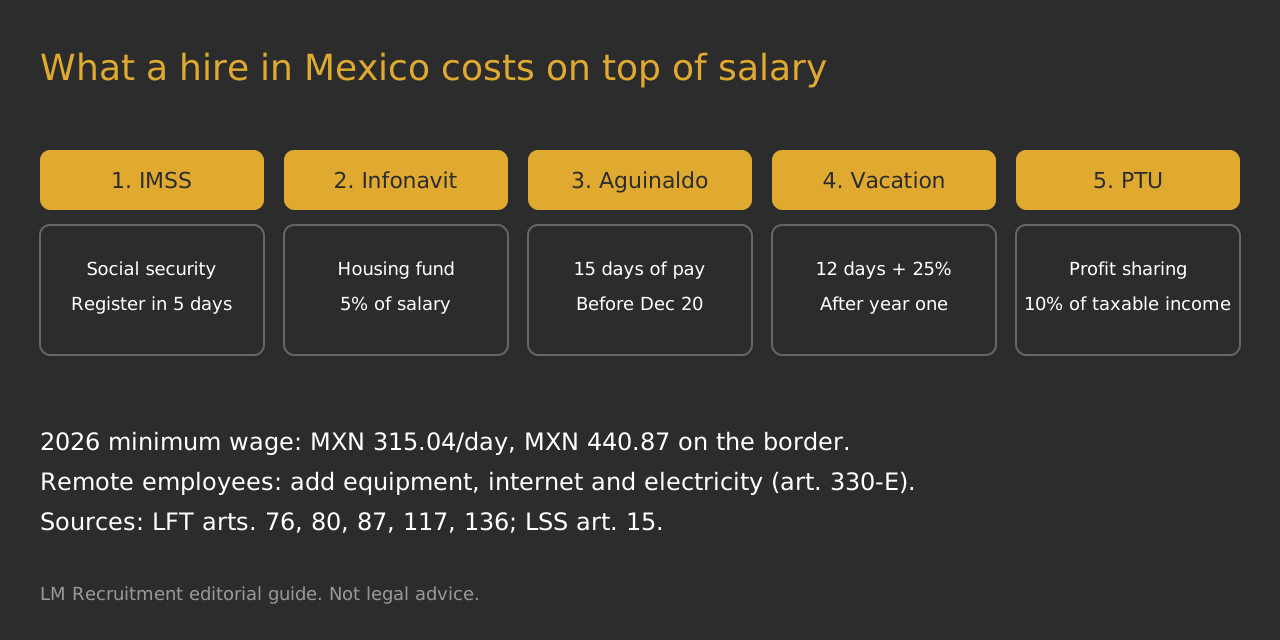
What It Costs to Hire an Employee in Mexico in 2026
Minimum wage, aguinaldo, vacation, IMSS, Infonavit and profit sharing: what an employee in Mexico really costs in 2026, with the law behind each line.
English Content
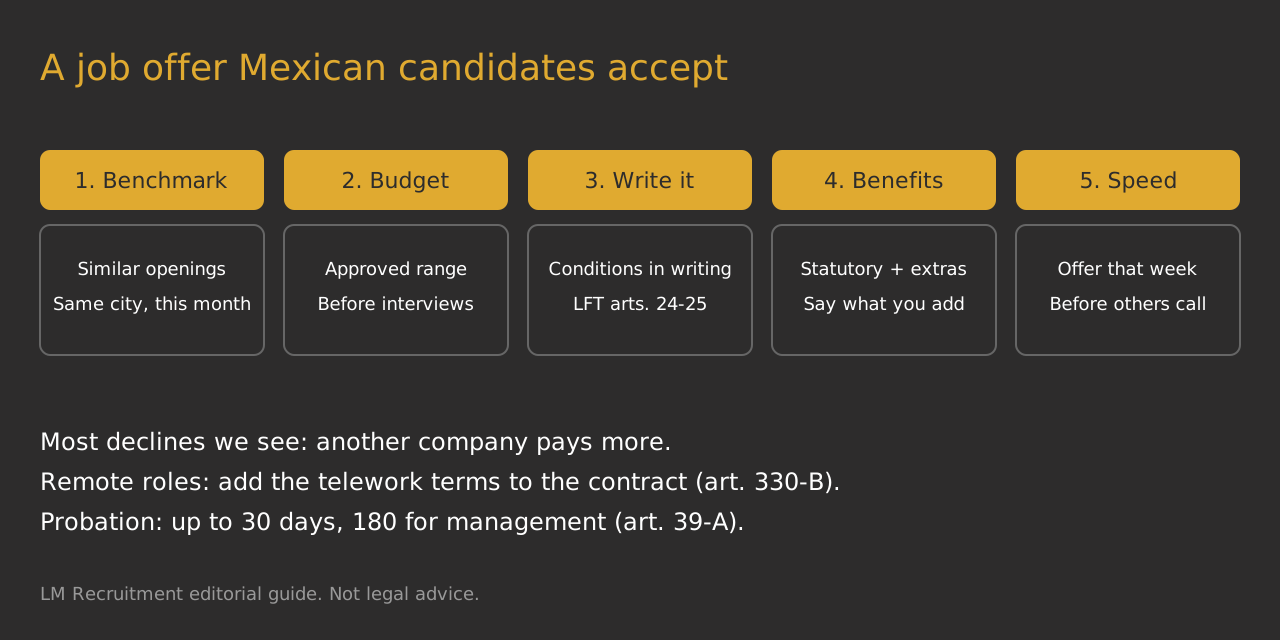
How to Make a Job Offer Mexican Candidates Accept
Why good candidates in Mexico turn down offers, how to benchmark salary against similar roles, and what a formal offer must include under Mexican law.
English Content
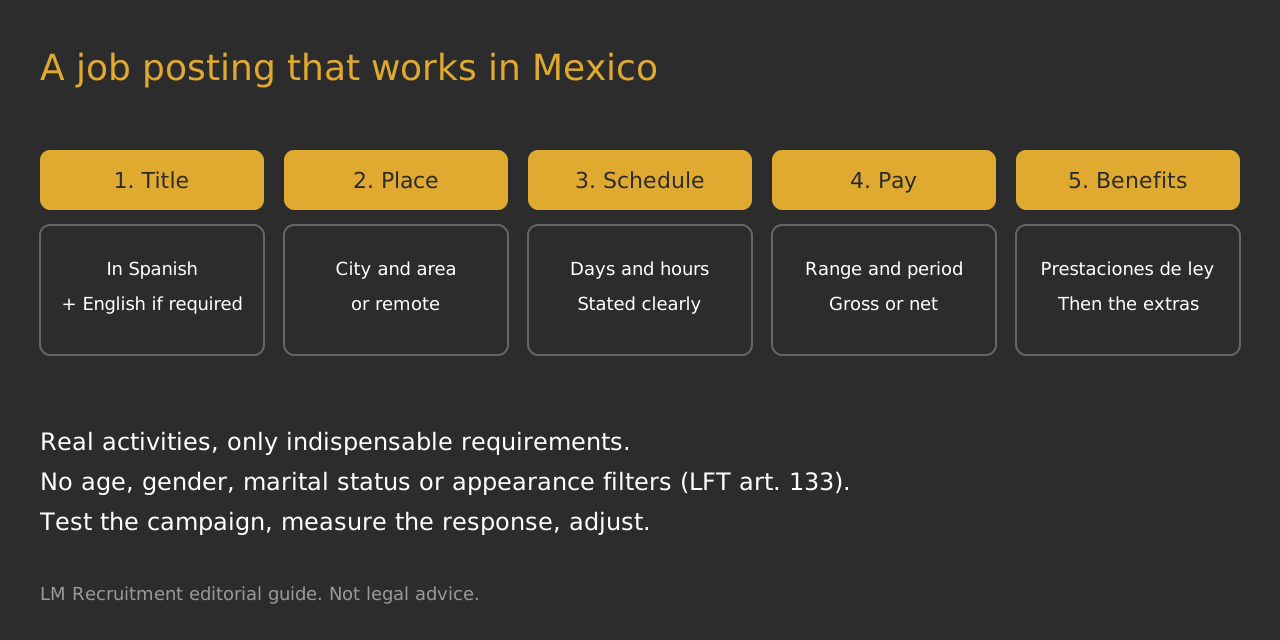
How to Write a Job Posting That Works in Mexico
What candidates in Mexico look for first, what makes a job posting look informal, and what Mexican law doesn't let you ask for. A checklist for US employers.